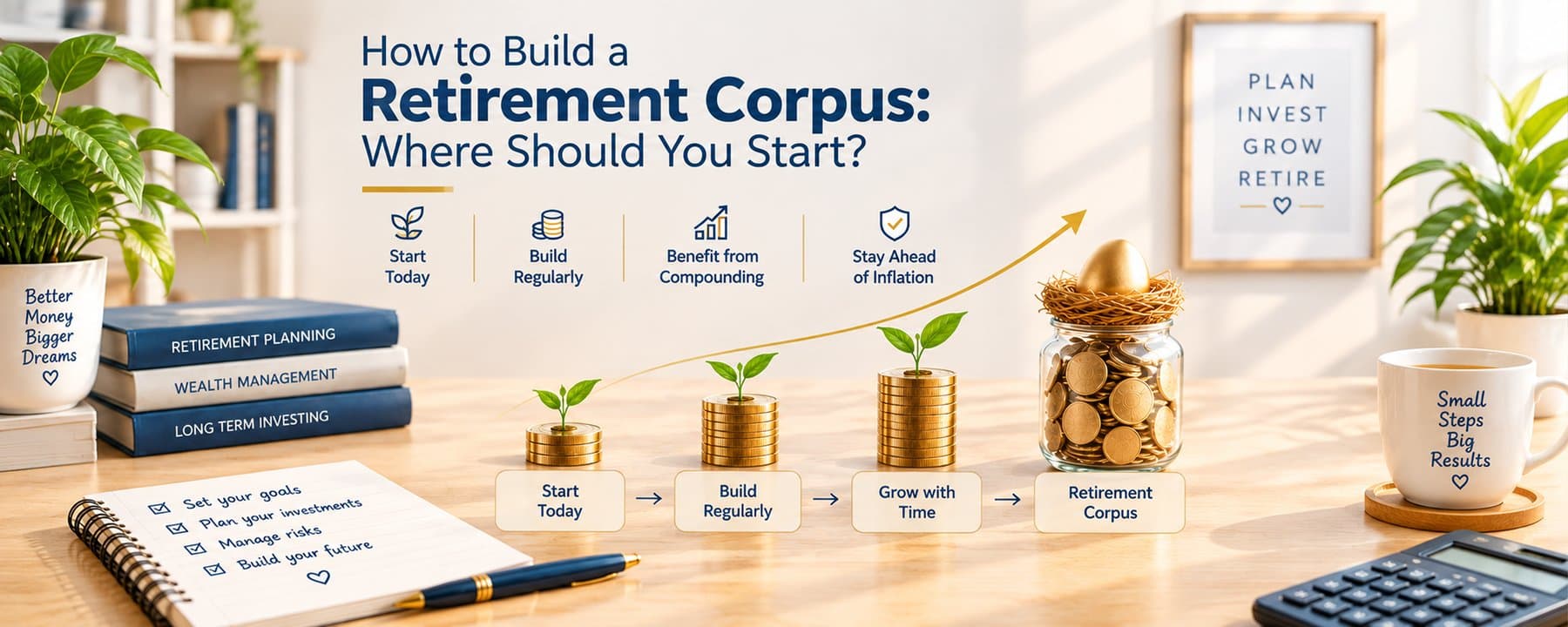
Retirement planning is not only about deciding when you want to stop working. It is about making sure you have enough money to support your lifestyle when regular employment income reduces or ends.
A retirement corpus is the pool of money you build over time to cover living expenses, healthcare, travel and other financial needs during retirement. The earlier you start, the more time your investments have to grow, and the lower the pressure may be on your monthly contribution.
The first step is not choosing a product. It is estimating the amount you may actually need.
Key Takeaways
- Your retirement corpus should be based on future expenses, not today's income alone.
- Inflation can significantly increase the amount you may need over a long retirement.
- Starting early can reduce the monthly investment required to reach your target.
- A mix of growth-oriented and relatively stable assets can help balance return potential and risk.
- Your retirement plan should be reviewed regularly as income, expenses and life goals change.
- As retirement approaches, protecting the accumulated corpus becomes increasingly important.
What Is a Retirement Corpus?
A retirement corpus is the total amount of money you aim to accumulate by the time you retire.
This corpus may need to support expenses such as:
- household costs;
- healthcare;
- travel;
- insurance premiums;
- rent or property maintenance;
- financial support for dependants; and
- lifestyle expenses.
Unlike a short-term goal, retirement may need to be funded for 20, 25 or even 30 years after you stop working.
That makes the size of the corpus especially important.
Why Should You Start Retirement Planning Early?
Starting early gives your investments more time to compound.
For example, an investor who begins at age 25 has several more years to build a corpus than someone who starts at 40.
This can make a significant difference because long-term investing depends on both:
- how much you invest; and
- how long the money remains invested.
Starting late does not mean retirement planning is impossible. It simply means you may need to invest more aggressively, increase contributions or revise some assumptions.
Step 1: Estimate Your Current Monthly Expenses
Start with your present household expenses.
Suppose your current monthly expenses are ₹60,000.
Not every expense will continue in retirement. Some may disappear, while others may increase.
For example:
| Expense | May Continue in Retirement? |
|---|---|
| Groceries and utilities | Yes |
| Rent or home maintenance | Yes |
| Commute to office | May reduce |
| Child education | May end |
| Healthcare | May increase |
| Travel and leisure | Depends on lifestyle |
This helps you estimate a more realistic retirement budget.
Step 2: Account for Inflation
One of the biggest retirement-planning mistakes is using today's expenses as the future requirement.
Inflation reduces purchasing power over time.
If your current monthly expenses are ₹60,000 and retirement is 20 years away, the same lifestyle could cost significantly more by then.
A simplified future-expense formula is:
Future Expense = Current Expense × (1 + Inflation Rate)^Number of Years
For example, assuming annual inflation of 6%:
₹60,000 × (1.06)^20
The equivalent monthly expense after 20 years would be approximately ₹1.92 lakh.
This is only an illustration. Actual inflation can vary across food, healthcare, housing and other categories.
Step 3: Estimate How Long Your Retirement May Last
You also need to estimate how many years the corpus may need to support you.
Suppose you plan to retire at 60 and want to plan until age 85.
That means your retirement corpus may need to fund around 25 years of expenses.
This matters because a longer retirement requires a larger corpus or a more sustainable withdrawal strategy.
You may also want to account for:
- increasing life expectancy;
- healthcare costs;
- spouse or dependant needs; and
- unexpected long-term expenses.
It is generally better to build some margin into the calculation rather than plan only for the minimum.
Step 4: Calculate the Retirement Corpus You May Need
Once you estimate future expenses and retirement duration, you can calculate a target corpus.
There are different methods for doing this, and the result depends on assumptions such as:
- inflation during retirement;
- expected investment returns;
- withdrawal rate;
- life expectancy; and
- pension or other income.
For example, if your estimated annual retirement expense is ₹24 lakh, multiplying that by 25 years would suggest ₹6 crore.
However, this simple method ignores investment growth during retirement.
A more detailed retirement calculator can estimate how the corpus may continue earning returns while withdrawals are being made.
The important point is to use a realistic target instead of choosing an arbitrary number such as ₹1 crore or ₹5 crore.
Step 5: Consider Existing Retirement Assets
You may not need to build the entire target from scratch.
Review assets already earmarked for retirement, such as:
- Employees' Provident Fund;
- Public Provident Fund;
- National Pension System;
- existing mutual fund investments;
- retirement-oriented investments;
- fixed deposits;
- pension benefits; and
- other long-term savings.
Subtracting the expected future value of these assets can help determine how much additional corpus you still need to build.
Avoid counting assets that are meant for other goals unless you genuinely plan to use them for retirement.
Step 6: Decide How Much You Need to Invest Regularly
Once you know the target corpus and current retirement assets, you can estimate the monthly investment required.
Suppose your target corpus is ₹4 crore and you have 25 years remaining.
A retirement calculator can help estimate the monthly SIP needed based on an assumed return.
If the required amount is currently too high, you may consider:
- starting with what you can afford;
- increasing the SIP every year;
- investing annual bonuses;
- extending the retirement age;
- reducing avoidable expenses; or
- reviewing your target assumptions.
The plan does not have to be perfect on day one. It needs to become progressively stronger.
Why SIPs Can Be Useful for Retirement Planning
A SIP allows you to invest a fixed amount regularly into a mutual fund.
For a long-term goal such as retirement, this can help build investing discipline and make contributions part of your monthly financial routine.
For example, you may invest ₹15,000 every month toward retirement instead of waiting to accumulate a large sum.
SIPs can help by:
- automating investments;
- spreading purchases across different market conditions;
- reducing the temptation to time the market; and
- allowing gradual increases as income rises.
However, the underlying investment still carries market risk.
Consider Using a Step-Up SIP
A step-up SIP increases your monthly contribution periodically.
Suppose you start with ₹15,000 per month and increase the amount by 10% each year.
As your salary increases, more money is directed toward the retirement goal.
This can be especially useful because a fixed SIP amount may become relatively small over a long period due to rising income and inflation.
Increasing contributions regularly can help close the gap between your current plan and your future corpus requirement.
Step 7: Build the Right Asset Allocation
Retirement is usually a long-term goal, so your investment mix may change over time.
When Retirement Is Far Away
If you have 15, 20 or more years remaining, growth-oriented assets such as equity may form a larger part of the portfolio, depending on your risk tolerance.
Equity can be volatile in the short term but may provide long-term growth potential.
When Retirement Is Closer
As retirement approaches, preserving the accumulated corpus becomes more important.
You may gradually increase exposure to relatively stable assets such as:
- debt mutual funds;
- fixed-income products;
- deposits; or
- other suitable lower-volatility investments.
The objective is to reduce the risk of a major market decline immediately before retirement.
Do Not Ignore Healthcare Costs
Healthcare can become one of the largest expenses during retirement.
Medical costs may increase faster than general inflation, and treatment needs can become less predictable with age.
Your retirement plan should therefore consider:
- health insurance premiums;
- out-of-pocket medical expenses;
- long-term treatment;
- medicines; and
- emergency medical costs.
A separate healthcare reserve may help prevent large medical expenses from disrupting the main retirement corpus.
Keep an Emergency Fund Separate
Your retirement portfolio should not be your first source of money for unexpected short-term expenses.
Maintain a separate emergency fund for:
- job loss;
- medical emergencies;
- major repairs;
- temporary income disruption; and
- other urgent expenses.
This can help you avoid redeeming long-term investments prematurely.
What Role Can NPS Play in Retirement Planning?
The National Pension System is specifically designed for retirement accumulation.
It allows investors to build a retirement corpus through a mix of asset classes and operates within a regulated pension framework.
NPS may form one part of a broader retirement portfolio, but it should not automatically be treated as the only retirement investment.
Before investing, consider:
- withdrawal rules;
- applicable tax treatment;
- asset allocation options;
- liquidity requirements; and
- your other retirement investments.
Diversification across suitable retirement assets can provide greater flexibility.
Should You Depend on EPF Alone?
EPF can be an important retirement asset for salaried employees, but whether it is sufficient depends on your income, contribution history and future expenses.
You should estimate the future value of your EPF and compare it with your total retirement requirement.
If the projected EPF corpus covers only part of the target, additional investments may be necessary.
Treat EPF as one component of the retirement plan rather than assuming it will automatically cover all future needs.
How Should You Reduce Risk Before Retirement?
Imagine you have built ₹3 crore by age 58 and plan to retire at 60.
If most of that money is still exposed to highly volatile assets, a major market decline could affect your retirement readiness.
Gradual de-risking can help.
You may consider shifting portions of the portfolio into relatively stable assets over several years instead of making one sudden change.
This approach can create separate pools for:
- near-term retirement expenses;
- medium-term needs; and
- long-term growth.
This can reduce the need to sell volatile investments during a market downturn.
Planning Withdrawals After Retirement
Retirement planning does not end when you build the corpus.
You also need a strategy for withdrawing from it.
A withdrawal plan should consider:
- monthly expenses;
- inflation;
- taxes;
- investment returns;
- healthcare costs; and
- how long the corpus needs to last.
Some investors may use a Systematic Withdrawal Plan from suitable mutual funds to generate periodic cash flow.
However, withdrawal amounts should be carefully planned so that the corpus does not get depleted too quickly.
Common Retirement Planning Mistakes
Starting Without a Target Corpus
Simply investing “for retirement” without knowing how much you need makes it difficult to measure progress.
Ignoring Inflation
A corpus that seems large today may not support the same lifestyle decades later.
Depending on One Investment
Retirement planning generally benefits from diversification rather than depending entirely on one asset.
Taking Too Much Risk Near Retirement
The closer you are to using the money, the less time you have to recover from a major market fall.
Underestimating Healthcare
Medical expenses can materially affect retirement finances.
Using Retirement Savings for Other Goals
Regularly withdrawing from retirement investments for weddings, home purchases or other goals can create a significant future shortfall.
How Often Should You Review Your Retirement Plan?
Review your retirement plan at least once a year and after major life changes.
Check:
- current monthly expenses;
- target retirement age;
- projected corpus;
- investment contributions;
- existing retirement assets;
- asset allocation; and
- progress toward the goal.
You should also review the plan after events such as:
- salary changes;
- marriage;
- birth of a child;
- home purchase;
- career break; or
- major healthcare changes.
Retirement planning should evolve as your financial life changes.
Conclusion
Building a retirement corpus starts with understanding the lifestyle you want to maintain and how much it may cost in the future.
Estimate your future expenses, account for inflation, consider the length of retirement and review the assets you already have. Once the target is clear, regular investing and periodic increases in contributions can help you work toward it.
Your strategy should also evolve over time. Growth may be the priority when retirement is far away, while stability and capital protection become more important as the goal approaches.
The earlier you begin and the more consistently you review your plan, the easier it becomes to make adjustments before a retirement shortfall becomes difficult to manage.