
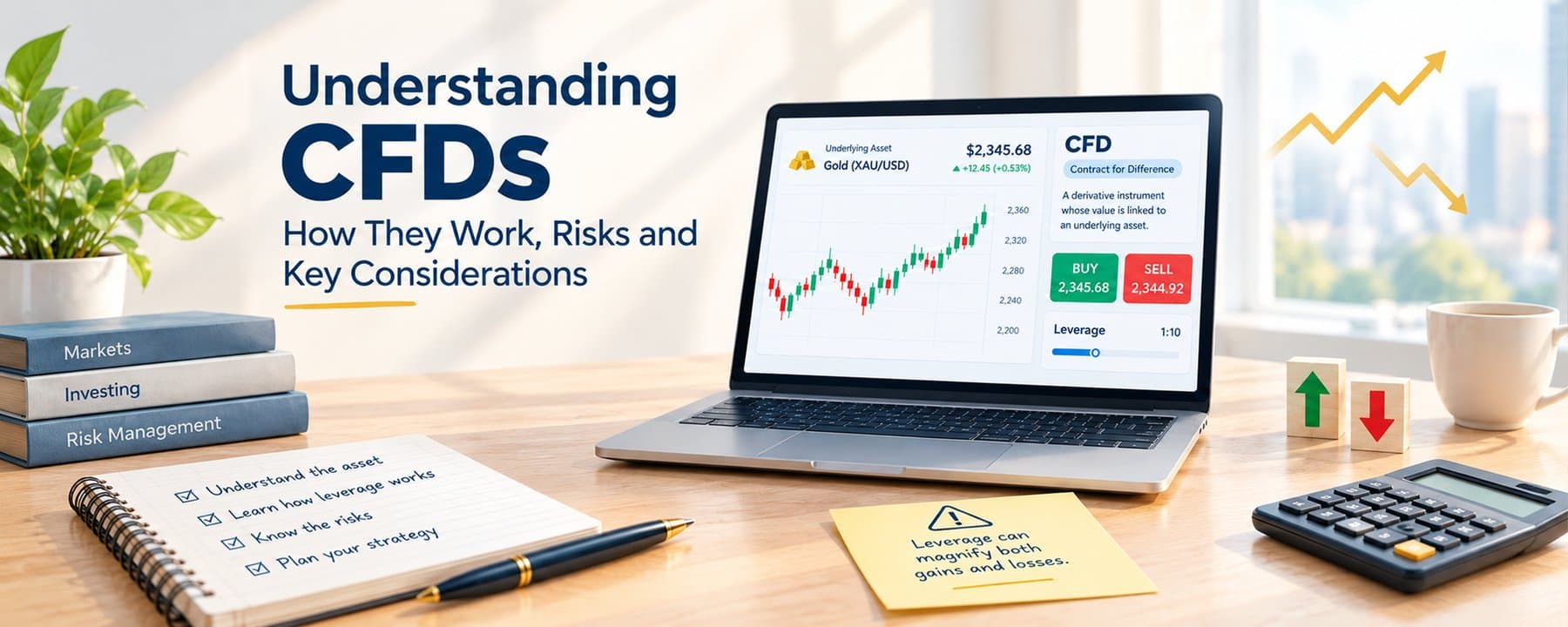
Contracts for Difference, or CFDs, are derivative instruments that allow traders to speculate on the price movement of an underlying asset without owning that asset directly.
They are commonly linked to shares, indices, commodities, currencies or other markets. Instead of buying the underlying investment, the trader enters into a contract based on the difference between the opening and closing price.
CFDs can provide market exposure with relatively small upfront capital because they are typically leveraged. That same leverage, however, can magnify losses as quickly as gains, making CFDs significantly riskier than conventional long-term investing.
For Indian investors, it is also important to understand the regulatory context before considering any overseas CFD platform. India has a regulated exchange-traded derivatives framework, while offshore derivative products may fall under different legal and foreign-exchange rules.
Key Takeaways
- A CFD is a derivative contract based on the price movement of an underlying asset.
- You do not own the underlying share, commodity, index or currency when trading a CFD.
- CFDs are usually leveraged, which means both gains and losses can be magnified.
- Traders may take either a long or short position depending on their market view.
- Fees may include spreads, financing costs, commissions and other platform charges.
- CFDs are high-risk instruments and are generally very different from long-term investing.
- Indian residents should verify the regulatory and foreign-exchange implications before using any offshore CFD platform.
What Is a CFD?
A Contract for Difference is an agreement between a trader and a provider to exchange the difference in the price of an asset between the time the position is opened and closed.
Suppose a CFD on a share is opened when the reference price is ₹1,000 and closed when the reference price reaches ₹1,050.
The difference is ₹50 per unit.
If the trader took a long position, that movement may result in a gain before fees. If the price had fallen instead, the same movement could have resulted in a loss.
The important point is that the trader is not buying or taking ownership of the underlying share itself.
How Does CFD Trading Work?
CFD trading generally involves choosing an underlying market and deciding whether you expect its price to rise or fall.
The basic process may involve:
- Choose an Underlying Asset: This could be an equity, index, commodity or currency pair.
- Select a Position: Go long if you expect the price to rise or short if you expect it to fall.
- Provide Margin: Only a portion of the total position value may be required upfront.
- Market Value Changes: Your profit or loss moves with the price of the underlying asset.
- Close the Position: The difference between the opening and closing price determines the trading outcome, subject to fees.
Because CFDs are leveraged, the total market exposure can be much larger than the initial amount deposited.
What Does Leverage Mean in CFD Trading?
Leverage allows you to control a larger position with a smaller amount of capital.
For example, suppose a CFD provider requires a 20% margin.
To open a position worth ₹1,00,000, you may need to deposit only ₹20,000.
This can appear attractive because a relatively small amount of money gives you exposure to a larger market position.
However, losses are also calculated on the full position value, not just on the margin you deposited.
That is why leverage is one of the biggest risks associated with CFDs.
A Simple CFD Example
Assume you open a CFD position linked to a share priced at ₹500.
You take exposure to 100 units.
Total position value = ₹500 × 100 = ₹50,000
If the provider requires a 20% margin:
Initial margin = ₹10,000
Now suppose the underlying price rises from ₹500 to ₹525.
The price increase is ₹25 per unit.
Potential gross gain = ₹25 × 100 = ₹2,500
That ₹2,500 gain is calculated against a position worth ₹50,000, even though only ₹10,000 was deposited as margin.
But if the price falls by ₹25 instead, the loss is also ₹2,500.
This illustrates how leverage magnifies both outcomes.
What Is the Difference Between Going Long and Going Short?
CFDs allow traders to take positions in either direction.
Going Long
You go long when you expect the underlying price to rise.
If the price rises, the position may generate a profit. If it falls, you may incur a loss.
Going Short
You go short when you expect the price to fall.
If the price declines, the position may generate a profit. If it rises, the position may incur a loss.
The ability to speculate on falling prices is one reason CFDs appeal to active traders.
It also increases complexity because losses can develop quickly when markets move against the position.
What Assets Can CFDs Track?
Depending on the provider and jurisdiction, CFDs may be linked to:
- shares;
- stock indices;
- foreign currencies;
- commodities;
- bonds;
- exchange-traded funds; and
- other financial markets.
The underlying market determines much of the price movement, but the CFD remains a separate derivative contract.
What Are the Main Risks of CFDs?
Leverage Risk
Leverage can amplify small market movements into large gains or losses relative to the cash deposited.
This is the most important risk to understand.
Market Risk
CFDs move with the underlying asset, so adverse market movements can quickly reduce the value of your position.
Highly volatile markets can produce large price swings in a short period.
Margin Calls
If losses reduce the value of your account below the required margin level, the provider may ask you to deposit additional funds.
If you do not meet the margin requirement, positions may be closed automatically.
Financing Costs
Holding leveraged CFD positions overnight may involve financing charges.
These costs can accumulate over time and reduce returns.
Counterparty Risk
A CFD is generally a contract with the provider.
This creates exposure to the financial strength, operational reliability and regulatory status of that provider.
Liquidity and Execution Risk
Fast-moving markets can create slippage, wider spreads or difficulty closing positions at the expected price.
What Fees Can Apply to CFD Trading?
The cost structure may include several components.
Spread
The spread is the difference between the buying and selling price.
A wider spread increases the cost of entering and exiting a trade.
Commission
Some providers charge a direct transaction commission.
Overnight Financing
Leveraged positions held beyond the trading day may attract financing charges.
Currency Conversion
If the CFD is denominated in a foreign currency, conversion costs may apply.
Inactivity or Platform Fees
Some platforms may impose additional account-related charges.
These costs can significantly affect the final trading outcome.
CFDs vs Buying Shares
The two approaches are fundamentally different.
| Feature | CFD | Direct Share Purchase |
|---|---|---|
| Ownership | No ownership of underlying asset | Investor owns the shares |
| Leverage | Common | Usually not used for ordinary investing |
| Ability to Short | Common | More restricted |
| Holding Period | Often short-term | Can be long-term |
| Dividends | Usually adjusted contractually | Actual shareholder entitlement |
| Risk Level | High due to leverage | Depends on company and market |
| Financing Costs | May apply | Usually not for fully paid shares |
For long-term wealth creation, direct investments generally behave very differently from leveraged CFDs.
Are CFDs the Same as Futures and Options?
No.
CFDs, futures and options are all derivatives, but their structures differ.
Exchange-traded futures and options are standardised contracts traded through recognised exchanges and clearing mechanisms.
In India, equity and other listed derivative contracts operate within a SEBI-regulated exchange and clearing framework, and brokers dealing in exchange-traded derivatives must be appropriately registered.
CFDs are commonly offered as over-the-counter products by providers in overseas markets rather than through Indian stock exchanges.
Are CFDs Regulated in India?
This requires particular caution.
India permits regulated derivatives trading through recognised exchanges and authorised intermediaries. SEBI regulates equity and other exchange-traded derivative segments, while RBI and SEBI prescribe rules for currency derivatives and foreign-exchange-related transactions.
Offshore CFD platforms are not the same as Indian exchange-traded derivatives.
An Indian resident considering an overseas CFD platform should not assume that the product is permitted simply because the website is accessible from India.
Foreign-exchange transactions involving Indian residents are subject to FEMA and RBI rules, and permitted derivative transactions may depend on the nature of the underlying exposure, the product and the authorised intermediary involved. RBI rules for foreign-exchange derivatives emphasise permitted channels and suitability requirements.
Before using an overseas CFD provider, investors should verify the legal and regulatory position carefully.
Why Are CFDs Considered High Risk?
CFDs combine several risk factors at once:
- leverage;
- short-term market movements;
- margin requirements;
- financing costs;
- potential forced liquidation;
- counterparty exposure; and
- complex pricing.
An investor may correctly predict the long-term direction of a market but still lose money if short-term volatility triggers a margin call before the expected move occurs.
This makes CFDs structurally different from simply holding a diversified mutual fund or equity portfolio over many years.
Who May Understand CFDs Better?
CFDs are generally more relevant to experienced market participants who understand:
- leverage;
- derivatives;
- margin requirements;
- stop-loss mechanisms;
- market volatility;
- trading costs; and
- the risk of rapid capital loss.
They may be unsuitable for someone whose primary objective is:
- retirement planning;
- child education planning;
- long-term wealth creation;
- capital preservation; or
- disciplined monthly investing.
What Should You Check Before Considering a CFD?
Before engaging with any CFD provider, review:
- whether the provider is regulated;
- which jurisdiction regulates it;
- leverage limits;
- margin-call rules;
- liquidation policy;
- overnight financing costs;
- spreads and commissions;
- withdrawal procedures;
- investor-protection mechanisms; and
- whether participation is legally permitted in your country.
You should also understand the maximum amount you could lose under the provider's terms.
CFDs and Long-Term Wealth Planning
CFDs are generally speculative trading instruments rather than traditional wealth-building products.
A long-term financial plan usually focuses on areas such as:
- asset allocation;
- diversification;
- SIPs;
- retirement planning;
- tax efficiency;
- emergency reserves; and
- disciplined investing.
CFDs operate differently because the objective is usually to profit from short-term price movements, often using leverage.
For this reason, they should not be treated as a substitute for a diversified long-term investment portfolio.
Common Mistakes to Avoid
Using Excessive Leverage
Higher leverage increases exposure but also reduces the amount of adverse price movement needed to create a large loss.
Trading Without Understanding Margin Rules
A position may be closed automatically if margin requirements are not maintained.
Ignoring Financing Costs
A profitable market view can still produce a poor result if financing charges accumulate over time.
Treating CFDs Like Ordinary Investments
CFDs are derivatives, not direct ownership of the underlying asset.
Using an Unverified Offshore Platform
Before depositing funds, investors should verify regulation, jurisdiction, investor protections and the legal position applicable to Indian residents.
Conclusion
CFDs allow traders to speculate on the movement of an underlying asset without owning it directly. Their structure can provide flexible market exposure, including the ability to take long or short positions.
However, leverage makes them substantially more complex and risky than conventional investing. Losses can escalate quickly, margin calls can force positions to close and financing costs can reduce returns.
For Indian investors, regulatory considerations are equally important. Domestic derivatives are traded within recognised and regulated frameworks, while offshore CFD platforms may involve different legal and foreign-exchange requirements.
Understanding the product, provider, leverage and regulatory environment should come before any decision to participate.